
PHERGain-2: HER2-pozitif erken meme kanserinde kemoterapisiz tedavi artık gerçek bir klinik stratejiye mi dönüşüyor?

HER2-pozitif erken meme kanseri uzun yıllar boyunca agresif biyoloji, yüksek nüks riski ve yoğun sistemik tedavi ihtiyacı ile birlikte düşünüldü. Trastuzumab, pertuzumab, T-DM1 ve daha yakın dönemde antikor-ilaç konjugatlarının bu alana girmesiyle tablo değişti. Artık temel soru yalnızca “daha etkili tedaviyi nasıl veririz?” değil; aynı zamanda “hangi hastada tedaviyi güvenle azaltabiliriz?” sorusudur.
ESMO Breast Cancer 2026’da sunulan ve Annals of Oncology’de eş zamanlı yayımlanan PHERGain-2 çalışması, bu soruya oldukça provokatif bir yanıt veriyor. Çalışma, küçük, nod-negatif, HER2 IHC 3+ erken evre meme kanserinde klasik sitotoksik kemoterapiyi tamamen dışarıda bırakan, patolojik yanıta göre şekillenen bir tedavi stratejisini test etti. Bu açıdan PHERGain-2 yalnızca bir de-eskalasyon çalışması değil; HER2-pozitif erken meme kanserinde tedavi yoğunluğunu biyolojik yanıta göre yeniden düşünmeye zorlayan bir çalışma olarak okunmalı.
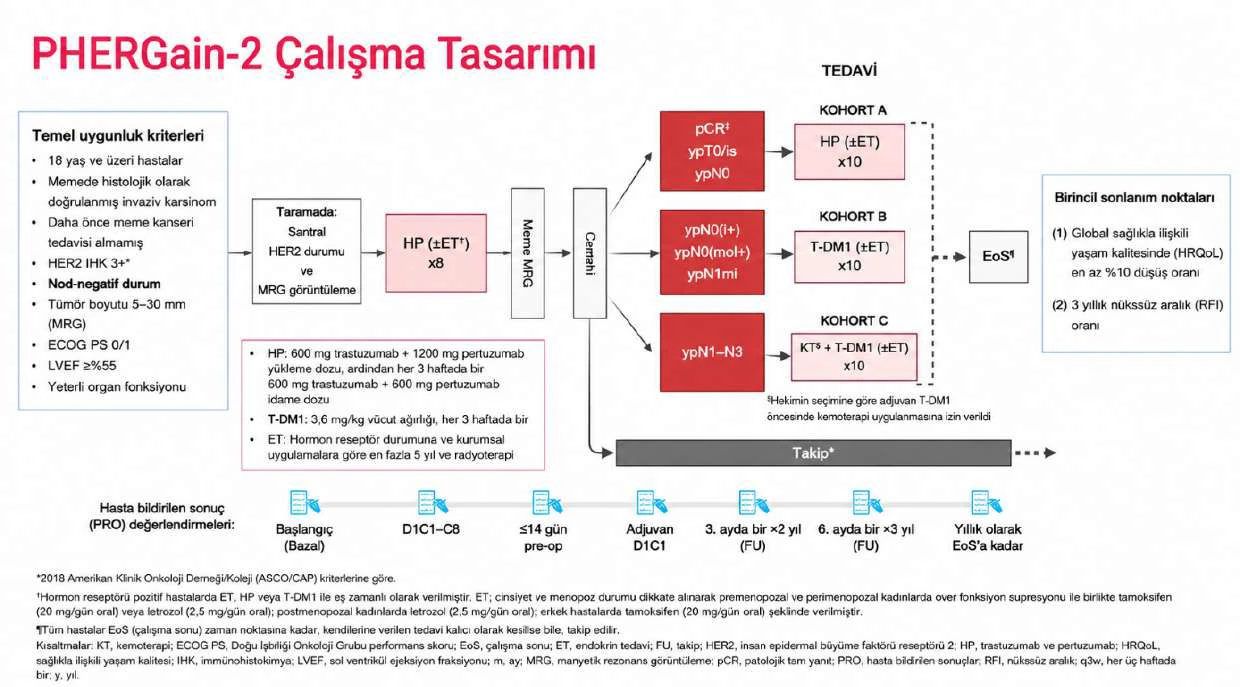
Çalışmaya daha önce tedavi almamış, santral olarak HER2 IHC 3+ doğrulanmış, nod-negatif, manyetik rezonans görüntülemeye göre 5–30 mm tümörü olan 396 hasta dahil edildi. Hastaların tümü neoadjuvan dönemde 8 kür trastuzumab-pertuzumab aldı; hormon reseptörü pozitif hastalarda buna endokrin tedavi eklendi. Cerrahi sonrası tedavi ise patolojik yanıta göre belirlendi: pCR elde eden hastalar trastuzumab-pertuzumab ile devam etti; rezidü invaziv hastalığı olan veya minimal nodal hastalık saptanan hastalar T-DM1 aldı; makrometastatik nodal hastalık gelişen küçük bir grup için ise T-DM1 öncesi kemoterapi seçeneği hekimin kararına bırakıldı.
Çalışmanın en dikkat çekici sonucu pCR oranıydı. Tüm popülasyonda meme ve aksillada patolojik tam yanıt oranı %59.6 olarak bildirildi. HR-negatif hastalarda pCR oranı %63.0, HR-pozitif hastalarda %58.3 idi. T1 ve T2 tümörlerde pCR oranının aynı düzeyde, %59.6 olarak saptanması da önemli; bu sonuç, bu seçilmiş popülasyonda yanıtın yalnızca tümör boyutuyla açıklanamayabileceğini düşündürüyor.
Bu verinin klinik ağırlığı şurada: Yaklaşık %60 pCR, klasik sitotoksik kemoterapi kullanılmadan elde edildi. HER2-pozitif hastalıkta bugüne kadar pCR çoğunlukla kemoterapi ile birlikte dual HER2 blokajının sonucu olarak düşünülüyordu. PHERGain-2 ise doğru seçilmiş hastalarda HER2 bağımlılığının tek başına güçlü bir terapötik kırılganlık yaratabileceğini gösteriyor. Bu, özellikle küçük, nod-negatif ve HER2 IHC 3+ tümörlerde tedavi paradigmasının gelecekte daha biyoloji-temelli kurulabileceğine işaret ediyor.
Yaşam kalitesi verileri çalışmanın ikinci önemli boyutu. Bir yıl sonunda global sağlık durumunda en az %10 kötüleşme oranı tüm popülasyonda %42.8 idi. pCR elde eden ve adjuvan dönemde trastuzumab-pertuzumab ile devam eden hastalarda bu oran %37.3 iken, pCR elde edemeyen ve çoğunlukla T-DM1 alan hastalarda %51.9’a yükseldi. HR-pozitif hastalarda yaşam kalitesi kötüleşmesinin HR-negatiflere göre daha fazla olması, muhtemelen endokrin tedavinin ek yükünü yansıtıyor.
Güvenlilik profili genel olarak beklenen sınırlar içindeydi. Tedavi ilişkili advers olaylar hastaların %86.6’sında görüldü; ancak grade ≥3 tedavi ilişkili advers olay oranı %5.6 olarak bildirildi. Ciddi advers olay oranı %6.1 idi. Bununla birlikte T-DM1’e bağlı bir pnömonit ölümü bildirildi. Bu nokta önemli: “Kemoterapisiz” yaklaşım “toksisitesiz” yaklaşım değildir. T-DM1, klasik kemoterapi gibi kullanılmasa da klinik olarak anlamlı toksisite potansiyeli olan bir antikor-ilaç konjugatıdır.
PHERGain-2’nin önceki PHERGain çalışmasından ayrıldığı kritik noktalar da var. Bu çalışmada ara PET yanıtına göre tedavi yönlendirmesi yapılmadı. Hasta seçimi baştan daha dar tutuldu: HER2 IHC 3+, nod-negatif, küçük tümörler. Ayrıca pCR elde edemeyen hastalarda adjuvan T-DM1 kullanımı stratejinin içine yerleştirildi. Bu nedenle PHERGain-2, yalnızca “kemoterapiyi çıkaralım” diyen basit bir çalışma değil; neoadjuvan dual HER2 blokajı ile tümörün biyolojik duyarlılığını test eden, ardından rezidü hastalığa göre tedaviyi yeniden düzenleyen bir model sunuyor.
Buna rağmen bu çalışmayı bugünden standart değiştirici olarak ilan etmek erken olur. PHERGain-2 tek kollu, açık etiketli bir faz II çalışma. Kontrol kolu yok. pCR değerlendirmesi merkezi yapılmadı. En önemlisi, 3 yıllık recurrence-free interval verisi henüz olgunlaşmış değil. Küratif erken evre hastalıkta kısa dönem pCR ve yaşam kalitesi verileri güçlü bir sinyal üretir; fakat standart pratiği değiştirmek için uzun dönem nüks ve sağkalım güvenliği görülmelidir.
Sonuç olarak PHERGain-2, HER2-pozitif erken meme kanserinde tedavi yoğunluğunu azaltma tartışmasını daha olgun bir zemine taşıyor. Kemoterapisiz trastuzumab-pertuzumab ile yaklaşık %60 pCR elde edilmesi, pCR sonrası tedavinin yine kemoterapisiz sürdürülebilmesi ve toksisite/yaşam kalitesi profilinin daha yönetilebilir görünmesi güçlü bir klinik sinyal veriyor. Fakat bu sinyalin karşılığı “kemoterapiyi kaldıralım” değil; “kemoterapiye gerçekten kimin ihtiyacı olduğunu daha doğru seçelim” olmalı.
Dr. Yakup Ergün
Yenilikçi Onkoloji Derneği
Kaynaklar
1-Garrigós L, Ruiz-Borrego M, Pérez-García JM, Guerrero-Zotano A, Cortés-Salgado A, Kuemmel S, et al. A chemotherapy-free, pathological response-adapted strategy using trastuzumab–pertuzumab and T-DM1 in HER2-positive early breast cancer: the PHERGain-2 study. Annals of Oncology. 2026. Published online. doi:10.1016/j.annonc.2026.01.013.
2-Garrigós L, et al. PHERGain-2: A chemotherapy-free, pathological response-adapted strategy using trastuzumab–pertuzumab and T-DM1 in HER2-positive early breast cancer. Presented at ESMO Breast Cancer 2026; 6–8 May 2026; Berlin, Germany.
PHERGain-2: Is chemotherapy-free treatment in HER2-positive early breast cancer becoming a real clinical strategy?
For many years, HER2-positive early breast cancer was associated with aggressive tumor biology, a high risk of recurrence, and the need for intensive systemic treatment. With the introduction of trastuzumab, pertuzumab, T-DM1, and more recently antibody–drug conjugates into this field, the landscape has changed. The key question is no longer only “How can we deliver more effective treatment?” but also “In which patients can we safely reduce treatment intensity?”
Presented at ESMO Breast Cancer 2026 and published simultaneously in Annals of Oncology, the PHERGain-2 study provides a highly provocative answer to this question. The trial tested a pathological response-adapted treatment strategy that completely omitted conventional cytotoxic chemotherapy in patients with small, node-negative, HER2 IHC 3+ early breast cancer. In this respect, PHERGain-2 should not be viewed merely as a de-escalation study; rather, it should be read as a trial that forces us to reconsider treatment intensity in HER2-positive early breast cancer according to biological response.
The study included 396 previously untreated patients with centrally confirmed HER2 IHC 3+, node-negative disease and tumors measuring 5–30 mm on magnetic resonance imaging. All patients received 8 cycles of neoadjuvant trastuzumab–pertuzumab; endocrine therapy was added for patients with hormone receptor-positive disease. Postoperative treatment was then determined according to pathological response: patients who achieved pCR continued trastuzumab–pertuzumab; those with residual invasive disease or minimal nodal involvement received T-DM1; and in the small subgroup that developed macrometastatic nodal disease, chemotherapy before T-DM1 was left to the physician’s discretion.
The most striking result of the study was the pCR rate. In the overall population, pathological complete response in both the breast and axilla was reported in 59.6% of patients. The pCR rate was 63.0% in HR-negative disease and 58.3% in HR-positive disease. It is also noteworthy that the pCR rate was identical in T1 and T2 tumors, at 59.6%. This finding suggests that, at least in this selected population, response may not be explained by tumor size alone.
The clinical weight of this finding is clear: an approximately 60% pCR rate was achieved without the use of conventional cytotoxic chemotherapy. Until now, in HER2-positive disease, pCR has largely been considered the result of chemotherapy combined with dual HER2 blockade. PHERGain-2 shows that, in appropriately selected patients, HER2 dependency itself may represent a strong therapeutic vulnerability. This points toward a future in which the treatment paradigm for small, node-negative, HER2 IHC 3+ tumors may be built on a more biology-driven foundation.
Quality-of-life data represent the second major dimension of the study. At 1 year, the rate of at least a 10% deterioration in global health status was 42.8% in the overall population. This rate was 37.3% among patients who achieved pCR and continued trastuzumab–pertuzumab in the adjuvant setting, whereas it increased to 51.9% among patients who did not achieve pCR and mostly received T-DM1. The greater deterioration in quality of life among HR-positive patients compared with HR-negative patients likely reflects the additional burden of endocrine therapy.
The safety profile was generally within expected limits. Treatment-related adverse events occurred in 86.6% of patients; however, the rate of grade ≥3 treatment-related adverse events was low, at 5.6%. Serious adverse events were reported in 6.1% of patients. Nevertheless, one death due to T-DM1-related pneumonitis was reported. This is an important point: “chemotherapy-free” does not mean “toxicity-free.” Although T-DM1 is not used like conventional chemotherapy, it is an antibody–drug conjugate with clinically meaningful toxicity potential.
There are also important differences between PHERGain-2 and the previous PHERGain study. In PHERGain-2, treatment was not guided by interim PET response. Patient selection was narrower from the outset: HER2 IHC 3+, node-negative, small tumors. In addition, adjuvant T-DM1 for patients who did not achieve pCR was incorporated into the treatment strategy. Therefore, PHERGain-2 is not simply a study that says “let us remove chemotherapy”; rather, it offers a model in which neoadjuvant dual HER2 blockade tests the biological sensitivity of the tumor, and treatment is then recalibrated according to residual disease.
Despite this, it would be premature to declare this study practice-changing today. PHERGain-2 is a single-arm, open-label phase II study. There is no control arm. pCR assessment was not centralized. Most importantly, the 3-year recurrence-free interval data are not yet mature. In the curative early-stage setting, short-term pCR and quality-of-life data generate a strong signal; however, long-term recurrence and survival safety must be demonstrated before changing standard practice.
In conclusion, PHERGain-2 moves the discussion on reducing treatment intensity in HER2-positive early breast cancer onto a more mature platform. Achieving an approximately 60% pCR rate with chemotherapy-free trastuzumab–pertuzumab, maintaining a chemotherapy-free approach after pCR, and observing a more manageable toxicity and quality-of-life profile together provide a strong clinical signal. However, the implication of this signal should not be “let us eliminate chemotherapy,” but rather “let us better identify who truly needs chemotherapy.”
Yakup Ergün, MD
Yenilikçi Onkoloji Derneği
References
- Garrigós L, Ruiz-Borrego M, Pérez-García JM, Guerrero-Zotano A, Cortés-Salgado A, Kuemmel S, et al. A chemotherapy-free, pathological response-adapted strategy using trastuzumab–pertuzumab and T-DM1 in HER2-positive early breast cancer: the PHERGain-2 study. Annals of Oncology. 2026. Published online. doi:10.1016/j.annonc.2026.01.013.
- Garrigós L, et al. PHERGain-2: A chemotherapy-free, pathological response-adapted strategy using trastuzumab–pertuzumab and T-DM1 in HER2-positive early breast cancer. Presented at ESMO Breast Cancer 2026; 6–8 May 2026; Berlin, Germany.